

It’s that time of year again, time to reflect on where we’ve been and share what’s ahead. 2025 was a year of challenges, learning, and growth for all of us here at HomeSeer, and we’re excited to pull back the curtain on our plans for 2026. Whether you’ve been with us for years or you’re just discovering what local smart home control can do, we think you’ll find plenty to be excited about. So grab a cup of coffee (or tea, we don’t discriminate) and let’s talk about where we’ve been and where we’re going next.
Lessons We Learned in 2025
Let’s start with the elephant in the room: tariffs. If you’ve been following the news, you know that 2025 brought some significant trade policy changes that rippled through the entire electronics industry. For a small company like ours, these shifts hit hard. We had plans, good plans, that we had to put on hold because our supply chains got turned upside down. Components we’d been sourcing for years suddenly became cost-prohibitive or unavailable, and we had to go back to the drawing board on several projects. It was frustrating, but it also taught us to be more agile and to build more flexibility into our product development timelines.
On a more positive note, we learned something important from you: you want to hear from us more often. When we started sharing more updates about what we’re working on, the response was overwhelmingly positive. So we’re committing to more regular communication throughout 2026. Expect more blog posts, more behind-the-scenes looks at what’s happening in our lab, and more transparency about our roadmap. We also spent a lot of time on the phone with many of you last year, just listening. Those conversations about your experiences with HomeSeer and with smart home technology in general were incredibly valuable. Thank you to everyone who took the time to chat with us. Your feedback directly shapes the decisions we make.
The State of Smart Home Tech
We just got back from CES 2026, and we have some thoughts on where the industry is heading.
Matter: Still More Talk Than Action. You’ve probably heard a lot about Matter, the new smart home interoperability standard that was supposed to unify everything. The big players are still talking about it, and yes, there are some Matter-compatible devices trickling onto the market. But honestly, we didn’t see anything groundbreaking at CES. The promise of Matter is compelling to those who ‘wouldn’t want all their devices to just work together?, but the reality hasn’t caught up yet. We’re keeping an eye on it, but we’re not betting the farm on it either.
AI Everywhere (Whether You Want It or Not). The other big trend we noticed is that AI is being shoved into absolutely everything. Some of this is genuinely useful such as in smart analysis of your energy usage, predictive maintenance alerts, that sort of thing. But here’s what concerns us: a lot of these AI features require you to connect to the cloud and share your data with the manufacturer. And why do they want that data? Too often, it’s to serve you ads. We saw devices at CES where ad delivery seemed to be a primary feature. Let’s be clear: ads are not a feature. Your smart home should work for you, not for advertisers.
Z-Wave and Zigbee Are Thriving. On the protocols we know and love, there’s actually great news. The Z-Wave 800 series continues to gain momentum, bringing improved range, better battery life, and a wave of new compatible devices. Zigbee also has a new protocol version rolling out, which means both of the primary local-control protocols are healthy and evolving. For those of us who believe in local control and privacy, this is exactly what we want to see.
Who We Are and Where We’re Headed
For those who might be newer to HomeSeer, here’s what we’re all about: we’re a smart home ecosystem provider and a fierce advocate for DIY home automation. Our mission is to empower you to create a richer home experience through reliable, locally-managed hubs and smart device networking equipment. No subscriptions required. No cloud dependency. Your data stays yours.
We’re also a small team, fewer than 10 people. That means we can be nimble and responsive to our community, but it also means we have to be smart about where we focus our energy. Over the past couple of years, we realized we’d gotten a bit distracted, chasing products and projects that didn’t really serve our core mission or, more importantly, didn’t serve you. So we’re narrowing our focus. In 2026 and beyond, we’re doubling down on what matters most: hubs, interfaces, wall switches, and the core functionality of our software platform. These are the building blocks of a great smart home, and we want to make them the best they can be.
One more thing we want to make crystal clear: we will never force AI into your smart home. If you want AI features, that’s your choice. If you don’t, your HomeSeer system will work beautifully without them. No walled gardens, no forced cloud connections, no compromises. You build your smart home the way you want it.
Changes to Our Product Portfolio
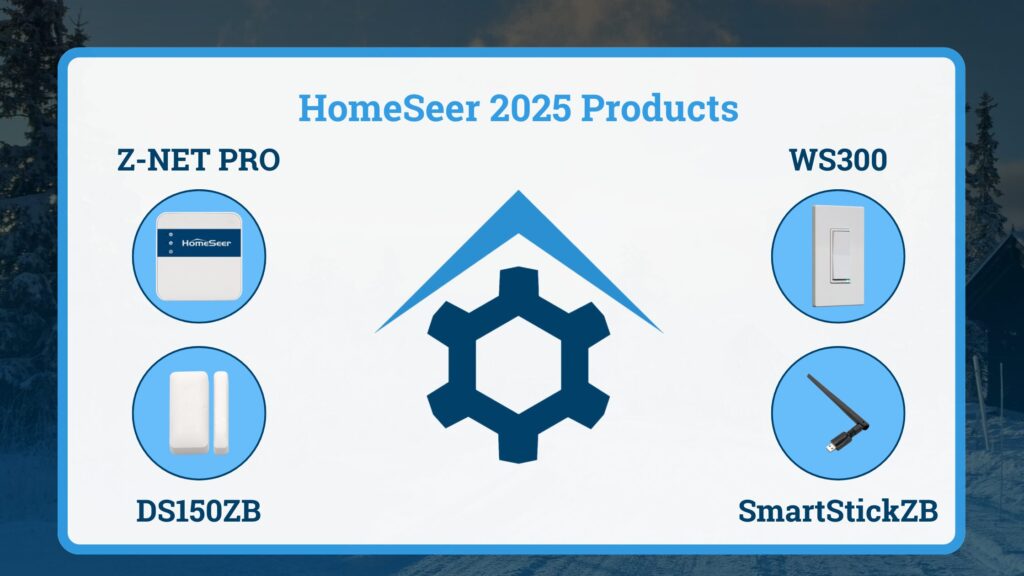
As part of our renewed focus, we’re making some changes to our product lineup. Some products are being retired, some new ones launched last year, and we’ve got exciting releases planned for 2026.
Products We’re Discontinuing
We’re saying goodbye to a handful of products. If you’ve been eyeing any of these, now’s the time to grab them. We’ll be offering discounts as we clear out remaining inventory.
- MS100 G8 – Being replaced by the upcoming PS100
- DS100 G8 – Already replaced by the DS150ZB
- HSM200 – Also being replaced by the PS100
- Z-NET G8 – Replaced by the Z-NET Pro
What We Released in 2025
Despite the challenges, we managed to get some solid products out the door last year:
- DS150ZB – A Zigbee door sensor for those of you building out Zigbee networks
- SmartStick ZB – A Zigbee USB interface that lets you add Zigbee capability to your existing setup
- WS300 – Our new Z-Wave in-wall switch, marking our return to switches after a hiatus
- Z-NET Pro – A dual-interface (Zigbee and Z-Wave) IP-accessible interface that gives you serious flexibility in how you design your network. We have been dealing with delay after delay on this one. More on this in a follow-up.
What’s Coming in 2026
Here’s what we’re working on for this year:
PS100 Presence Sensor (Target: Q2). We’ve been talking about this one for a while, and we promise it’s actually happening this year. The PS100 is a Z-Wave presence sensor that uses radar technology instead of traditional infrared (PIR). Why does that matter? Radar can detect presence even when you’re sitting still, so no more waving your arms to keep the lights on. We’ve received great feedback on the designs and will be sharing updates in the coming months.
WD300 Dimmer (Target: Q4). Following the release of the WS300 binary switch, we’re bringing back a dimmer to our lineup. It’s been tough not having switches and dimmers available, since that’s been one of our core product categories for years. The WD300 will round out our in-wall control options and should be available in Q4.
Software Updates
Our software platform is the heart of the HomeSeer experience, and we’re committed to making it better. Starting in March, we’ll be moving to a quarterly update schedule. This gives us a regular cadence to deliver improvements, bug fixes, and new features without the chaos of unpredictable release cycles. We’ll have a separate, more in-depth blog post coming soon that dives into our software roadmap, so stay tuned for that.
Looking Ahead
2025 was a year that tested us, but it also reinforced why we do what we do. There’s something deeply satisfying about building a smart home that you truly own and control, one that doesn’t spy on you, doesn’t serve you ads, and doesn’t stop working because some company decided to shut down their cloud servers. That’s the future we’re building toward, and we’re grateful to have you along for the ride.
As always, we’d love to hear from you. Drop us a line, join the conversation on our forums, and make sure you subscribe to our newsletter. We will be prioritizing our newsletter as our primary point of communication with you moving forward. Here’s to a great 2026!







3 thoughts on “HomeSeer 2026: What We Learned, Where We’re Going, and What’s Coming Next”
I should add for Jon-Luke. I am an instrument rated private pilot with about 1,000 hours and have flown coast to coast and into Canada. I have never understood jumping out of an airplane with the wings still attached.
I have been using Homeseer since 2001. I discovered the software when I was in a lighting shop trying to find the lighting fixtures for a home theater I was developing. I think I paid about 39.95 for the original software and had an early Windows PC as the hardware. I used it in the theater to:
IR controls to turn on and off various components
X10 to dim and bring the theater lights down and up.
I had started coding in 1994 so was able to generate the Basic code that I needed to get the job done. The forums and others including you folks at Homeseer provided help as needed. Thanks.
I am now using HS4 on one of your Hometrollers along with the HS4 Designer on a Win 11 pro machine (although I consider Win 11 pro an abomination before the Lord). I must say things are a lot easier today than they were in 1994 although the total complexity with what can be done is much larger in scope. I now center drapes, lights, etc. on Zwave technology. I use both the Designer and Homeseer Mobile, and I must confess, I have never taken the time to really master the Designer. I generate what I need and have begun to use castoff Ipads as display devices as needed. I still use a couple of Oregon Scientific sensors to monitor refrigerator and freezer temps without any connection other than radio waves. I do not use a lot of plugins such as Sonos or Honeywell thermostats because I finds it much easier to use things like the native Sonos app to control my sound system or the native Honeywell app to control my HVAC system. It has always seemed better to me to avoid layering up software systems on top of each other because when a problem occurs, finding the source can be more challenging in layered systems. I do use some connections to Alexa but these are limited as I have no desire to talk to everything. I am old fashioned I suppose but I still find pushing buttons on a TV remote is easier than trying to remember the correct phrases even if I developed them myself. And I find grabbing a remote and pushing a button is a lot easier than brining up a screen on a phone or Ipad or some such as a phjysical remote is tactile and fast. I do use castoff Ipads as displays for certain things.
Thanks again for all that you have done. My latest thought was to update my Zwave controller (Aeotech gen 5) but that would involve rescanning and rebuilding over 30-40 Zwave items so have not done that. I did chat with someone at HS maybe six months ago but it did not seem an easy change controller path was available and I did not want to climb ladders to re-pair over 10 window drape sets among other things.
A little history from one of your early users.. Keep up the good work.
Love homeseer’s focus on local, private automation! Also love the app builder and its flexibility.
Thank you Homeseer team for your dedication to this mission!
Comments are closed.