
As of November 2025 Zigbee 4.0 has been announced. As with any big update there is a lot of information to sort through. So we have collected some broad points to give the gist of what to expect as it is rolled out.
Technical Details of the update
Highlights
- Sub-GHz support (“Suzi”): Zigbee 4.0 adds optional physical layers for 800 MHz in Europe and 900 MHz in North America to provide longer ranges and better building penetration than 2.4 GHz.
- Updated security: New protections such as advanced frame-counter synchronization, unique link-key monitoring, and improved Trust-Center handling to reduce replay and rejoin attacks and generally protect networks.
- Simpler onboarding: BLE-assisted onboarding / Zigbee Direct and Batch Commissioning make it easier to add many devices quickly
- Better sleepy device behavior & network reliability: Standardized network-level retries, improved polling for battery longevity,and expanded APS acknowledgements aim to reduce message loss and increase battery life.
- Full backward compatibility with Zigbee 3.0 & Smart Energy: Existing Zigbee 3.0 devices and hubs continue to work; vendors can ship Zigbee 4.0 devices that interoperate with the large installed base.
Frequency / PHY: 2.4 GHz still supported; Sub-GHz (Suzi) added
Zigbee 3.0 standardized on the IEEE 802.15.4 2.4 GHz PHY globally. That frequency is great for bandwidth and device density but suffers in range and wall penetration. This should improve functionality in environments such as gardens, garages, or large multi-story installations.
Zigbee 4.0 keeps the 2.4 GHz PHY but adds formal support for sub-GHz PHYs (the “Suzi” initiative). Suzi provides support for 800 MHz in Europe and 900 MHz in North America, delivering longer radio range, improved penetration through walls and foliage, and reduced interference in crowded 2.4 GHz environments.
Onboarding & commissions: BLE & Batch Commissioning
Zigbee 3.0 workflows often relied on hub-centric procedures and per-device joining that could be fiddly for end users.
Zigbee 4.0 introduces Bluetooth Low Energy (BLE) assisted onboarding and Batch Commissioning, allowing multiple devices to be commissioned together or letting a smartphone initiate setup without a hub in some cases. This makes setup easier for the average consumer and reduces time for installers handling many endpoints. Vendors can support local phone-to-device interactions for commissioning, diagnostics, and OTA initiation.
Security: stronger, more modern protections
Key security improvements:
- Advanced frame counter synchronization to reduce replay attacks and improve rejoin behavior.
- Unique Link Key Monitoring and better Trust Center controls so compromised devices are easier to detect and isolate.
- Hardened onboarding and restricted modes to prevent unauthorized joins or key swaps.
These changes modernize Zigbee’s security posture and align it more closely with expectations for today’s IoT ecosystems. They also help vendors meet stricter regulatory and enterprise security requirements.
Reliability & sleepy devices: network-level fixes
Zigbee 4.0 standardizes network-level retries and expands APS (application support sub layer) acknowledgements, improving how the stack handles temporary routing failures and intermittent links. For sleepy end devices (battery sensors), Zigbee 4.0 specifies more reliable polling mechanics and scheduling that can reduce unnecessary wake cycles — improving battery life while keeping data delivery dependable.
Certification & profiles: streamlining the ecosystem
CSA has emphasized that Zigbee 4.0 streamlines certification and keeps compatibility with Smart Energy profiles. That reduces fragmentation for manufacturers who want to support both legacy Zigbee profiles and new 4.0 capabilities. The goal is to avoid the “forked” ecosystems that can confuse customers and integrators.
Backwards compatibility
Zigbee 4.0 will play nicely with your Zigbee 3.0 devices. Zigbee 4.0 is explicitly designed to be backward compatible with Zigbee 3.0, so there is no ambiguity. That means your existing bulbs, sensors, and hubs won’t suddenly stop working when vendors ship Zigbee 4.0 devices. In practice:
- A Zigbee 4.0 coordinator/hub should be able to talk to Zigbee 3.0 endpoints (and vice versa where hardware allows).
- Sub-GHz (Suzi) devices will be optional — a 4.0 device using sub-GHz radios cannot talk on a 2.4 GHz-only legacy radio, but the logical Zigbee stack and profiles remain compatible. In other words, radio-level compatibility depends on PHY: 2.4 GHz devices interoperate normally; long-range Suzi devices interoperate at the application layer but require sub-GHz transceivers for radio comms between themselves.
What this means for you:
- If you have a 3.0 hub today you will still be able to use your 3.0 devices.
- Upgrading to a 4.0-capable hub gives you access to new features (BLE onboarding, batch commissioning, Suzi devices, and security improvements).
- If you buy a Suzi sub-GHz device, ensure the coordinator/hub supports sub-GHz; otherwise the device will need a Suzi-capable gateway or act as a device toward a Suzi-enabled coordinator.
If you plan to migrate to Zigbee 4.0
- Don’t panic. If your current system works, you can keep using it. Zigbee 4.0 is backward compatible.
- When buying new hubs, look for vendors that explicitly state which 4.0 features they support (e.g., BLE onboarding, Suzi radio hardware, batch commissioning).
- For Suzi use cases (outdoor lights, remote sensors), verify both the device and the coordinator/hub are Suzi-capable. Expect this to be an optional, premium feature early on.
- Check firmware/OTA paths: vendors who offer secure OTA updates will be able to push some 4.0 stack improvements to existing devices where hardware allows. However, radio-level changes (sub-GHz) require new hardware.
Unknowns
- Suzi adoption timeline: while the standard has been announced the ecosystem roll-out (chipsets, certified devices, hubs with sub-GHz radios) will take some time. Expect a phased adoption over the next 12–24 months.
- Interference and regional rules: Sub-GHz band allocations and transmission limits differ by country device vendors must respect regional regulations.
- Matter and ecosystem overlap: Matter continues to grow; Zigbee 4.0 is not a replacement for Matter but a modernization of the existing Zigbee install base. Gateways and bridges will continue to play a role in heterogeneous smart homes.
HomeSeer Zigbee Devices
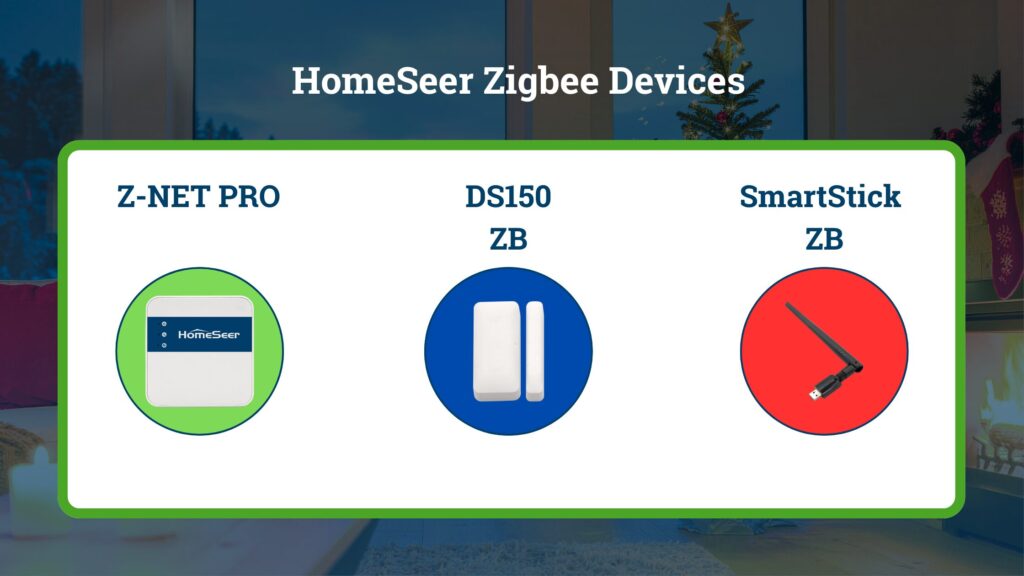
Don’t forget to check out HomeSeer’s latest Zigbee powered devices At the top end, the Z-NET PRO is a dual radio network-attached Zigbee/Z-Wave interface designed for professional-grade reliability and flexible placement anywhere on the LAN ideal for large homes and custom installs where optimal radio positioning is critical. For plug-and-play simplicity, the SmartStick ZB delivers powerful Zigbee control in a compact USB stick form factor, making it perfect for DIY users who want fast, affordable Zigbee integration directly into their HomeSeer system. Rounding out the lineup, the DS150ZB which is a discreet small form factor Zigbee door and window sensor with excellent battery life.
Check out our Holiday Sale!

Just a reminder that HomeSeer’s Holiday 2025 Sale is still ongoing, so if your missed out on our Black November Sale but you still want to get our products at great prices click the link below and check it out!





1 thought on “Zigbee 4.0: What to expect”
It’s really a nice and helpful piece of info. I’m happy that you simply shared this helpful
info with us. Please keep us informed like this. Thanks
for sharing.
Comments are closed.